Thursday, March 19, 2015

Database Resources for Papers


Hi, class,

I am providing you with basic database searching instructions. This will be of great assistance to you when you begin work on the research paper in April.


DATABASE RESOURCES
Here are the instructions (the emphasis here is on the Literature Resource Center—LRC, as an example). To access The Literature Resource Center, and Contemporary Authors/Literary Criticism Select/Dictionary of Literary Biography, go to:


The password is: county


Click "Proceed"
 

Click on Literature Resource Center - LRC
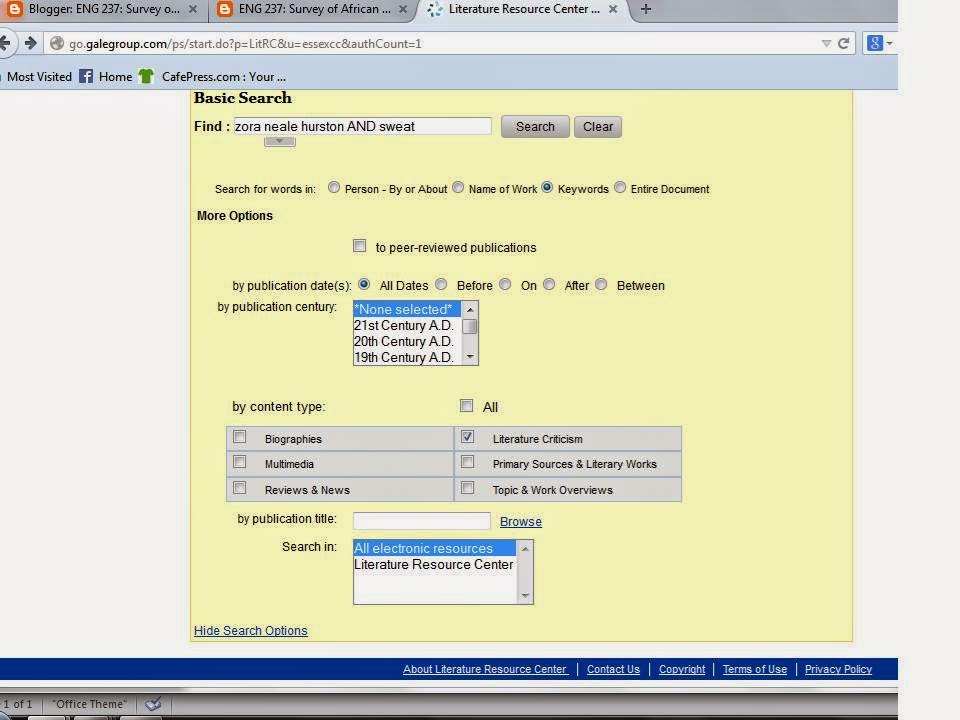
1) When you get to the search box (FIND), just type in your search terms:

EXAMPLES:


  • crane AND monster
  • Frankenstein AND nature AND nurture
  • AND two offers 
  • harriet wilson AND our nig
  • morrison AND bluest eye
  • douglass AND heroic slave


2) under “publication century,” CLICK “21st century A.D.” 

3) under “by content type,” UNCHECK all the boxes EXCEPT “Literature Criticism”

4) Make sure “All electronic sources” is highlighted (it is the default).

5) Then CLICK “Search” (next to where your search terms were entered).

Several articles will come up--skim through to see if you find some suitable articles. If you cannot find articles that work, try using other search terms. Click on the ones you think might be suitable, and email them to yourself, or download them. If you cannot find suitable articles from "21st century A.D.," click "None selected" and do your search again.
 

TEXTS AVAILABLE IN LIBRARY 
In addition, there are many books on the authors we have studied accessible from the Essex County College Library. For books, you may use works (biographies, collected essays, etc.) published no earlier than the year 2000. Look for the book using the call letters. If you cannot find the books you want to use in the stacks, ask the reference librarian for assistance. You also have access to the Rutgers-Newark Library with your ID card, so feel free to access articles from their resources.

Tuesday, March 3, 2015

Comments on Strange Case of Dr. Jekyll and Mr. Hyde


Hi, class, please feel free to respond to any (or all) of the questions posted below.


1) Throughout Strange Case of Dr. Jekyll and Mr. Hyde, everyone who encounters Hyde finds it difficult to describe his looks. Why do you think author Robert Louis Stevenson avoids having the characters provide a precise visual description of Hyde?

2) In the section, “Henry Jekyll’s Full Statement of the Case” in the Norton (49-62), Henry Jekyll writes of  the “…thorough and primitive duality of man,” which causes him to explore that duality through his scientific experiments: “Even at that time, I had not yet conquered my aversion to the dryness of a life of study I would still be merrily disposed at times; and as my pleasures were (to say the least) undignified, and I was not only well known and well considered, but growing towards the elderly man, the incoherency of my life was growing daily more unwelcome, It was on this side that y new power tempted me until I fell into slavery. I had to but drink the cup, to doff at once the body of the noted professor and to assume, like a thick cloak, that of Edward Hyde” (52). In an essay, find passages to compare the repressed and dry life of Dr. Jekyll with the exciting and unhallowed pleasures of Edward Hyde. Why, in the final analysis, do you think Edward Hyde triumphed of Jekyll?

3) Some critics view Strange Case of Dr. Jekyll and Mr. Hyde as exposing anxieties in the British Empire, with the main conflict as symbolic of threats regarding race, class, sexuality (including homosexuality), Darwinism, and immigration at the end of the 19th Century. Find and analyze one or more passages within the story and write an essay to support or refute such claims.

Thursday, February 19, 2015

Electronic Edition of Frankenstein - and keyword searching!


On-line text of Frankenstein/searching using keywords/additional critical approaches and definitions/contexts

Hi, class,

The group exercise, in which you were to examine the various critical approaches to Frankenstein (Marxist, feminist, psychoanalytic, etc.) was so that you would gain an understanding of all of them more quickly.  Again, this was mainly for reasons of expediency--you need not stick to that approach for your research paper. 

Below is the University of Pennsylvania's Electronic Edition of the 1818 Frankenstein. Cut and paste it into your browser, and try doing a search, if you think it might help you move more quickly to the chapters/passages that you think will be most helpful to you when you begin to write. 

Try using the specific keywords that relate to the approach you are using. For example, try "dream" and "sleep" if you are using a psychoanalytic approach and writing about Victor's unconscious state--try using "glory" if you want to do a comparison/contrast of Walton and Victor, etc. 

Of particular value to you are the "Table of Chapters" and the "Contents." If you click on one of the chapters in "Table of Chapters," you will see that the text has links to clearer explanations of terms, along with more contexts. If you click on "Contents," you will see a variety of materials that are available to you. Some (like the "Critical Approaches" page) are unavailable, but in terms of providing some overall background and over 200 critical essays on the text, this is a great site.

  
I would caution you, however, that you should use this site primarily for help in understanding some of the contexts of Frankenstein, and to assist you in finding good research articles. You are to do your own writing--do not depend on this site for YOUR critical analysis--I want to know what YOU are thinking in relation to your chosen theme.

Click on this link to be taken to a host of critical essays on Frankenstein


BEFORE YOU FEEL OVERWHELMED, THOUGH, here is a trick for getting to what you may be searching for more expediently!

Go on Google. In the search bar, type what you want Google to search for. For example, for those of you using the psychoanalytic approach, you may want to try the word "psychoanalytic." Just enter the following into the search bar:

psychoanalytic site: http://www.english.upenn.edu/Projects/knarf/Articles/index.html

Or enter "freud," like this:

freud site: http://www.english.upenn.edu/Projects/knarf/Articles/index.html

Or enter "feminism," like this:

feminism site: http://www.english.upenn.edu/Projects/knarf/Articles/index.html

Or enter "race," like this:

race site: http://www.english.upenn.edu/Projects/knarf/Articles/index.html

Google will then search for that word in the Articles directory of the website--try it--it can save you time! 

A word about "plagiarism": Please note, especially in using on-line sources for critical support, that you must annotate your sources immediately if you are cutting and pasting them for use in your paper--it is easy to inadvertently paste a piece of documentation without attribution. You should cite your sources properly and make sure that you use quotes. Do not depend solely on your sources for analysis-write your own analysis and try to find a source that supports it. In addition, you may find an article that contradicts your own findings--argue with that source! Feel free to disagree, but find textual support in Frankenstein for your own ideas.

Finally, although this paper is a research project, you should be having fun! Frankenstein is a pleasure to read and analyze--I am enjoying the class's critical discourse, and I know that you will continue to provide rich and thoughtful commentary!

All best,

Prof. Williams


Wednesday, February 18, 2015

Guidelines for Frankenstein Research Paper - New Due Dates!

ASSIGNMENT: You will write a fully documented, multiple-sourced research/literary analysis paper (approximately 7-10 pages in length), which will follow MLA guidelines in matters of form (see MLA in-text citation style below—for complete MLA style, click at left on course blog), and it will contain a Works Cited Page, in-text citations to those sources, and a complete outline. For your first paper, you must use a total of eight (8) in-text citations from at least three (3) sources, in any combination. 


 Your first paper, on Mary Shelley’s Frankenstein, will focus on a theme of interest to you. For this paper, you will be examining the novel utilizing a particular critical perspective—psychoanalytic, feminist, gender studies, Marxist, critical race theory, or cultural criticism. You may utilize some of the articles you read or some from the handouts I provided as part of your Works Cited sources, or you may find others. We will have a brief “brainstorming” session on Tuesday, 2/24 to assist you in developing your first paper. Please bring in a draft of your abstract on Tuesday as well.


  The 1st research paper (Frankenstein) will be due on Tuesday, 3/3, at MIDNIGHT via email. Late papers may be subjected to a loss of 3 points. You may submit your paper early. In the interest of fairness, please do not ask me to make an exception for you.


 NOTE: For research papers, YOU MAY NOT USE the following as sources, as they are NOT considered scholarly works: SparkNotes, CliffsNotes, ClassicNotes, Enotes, GradeSaver, or any other student guides.  


A Wikipedia entry may NOT be used as a source—however, if the “Source” section of a Wikipedia entry contains a scholarly work (a journal article or academic book) that you want to quote from in your paper, you are free to retrieve the work from the library (hard copy or from a database) and incorporate it into your paper.
  

 ANY INSTANCE OF PLAGIARISM IN THE RESEARCH PAPER WILL RESULT IN AN “F” ON THE ENTIRE PAPER WITH NO POSSIBILITY FOR REVISION.


 SUBMISSION DATES
ABSTRACT: Students must present a one paragraph abstract of approximately 75-100 words summarizing the paper--also, let me know what critical essays you intend to use to complete the assignment (to the bet of your ability). Due Thursday, 2/26


BIBLIOGRAPHY: You must present a Bibliography of sources (books, journal articles, newspaper articles, media sources, Internet sources) that you think you be using for your research paper. The page will consist of no fewer than three (3) critical sources.  At least two (2) of the sources must come from scholarly books or articles on the main topic. Internet sources can comprise no more than one (1) of the sources. Due Thursday, 2/26   

OUTLINE: An outline is required as part of the grade for the research paper. This outline must directly correspond to the research paper and may be handed in with the paper. Due Thursday, 3/3 (submit with your paper)


THIS PAPER IS DUE ON TUESDAY, 3/3, by midnight.
 

ANY PAPER SUBMITTED AFTER THIS DATE AND TIME MAY RESULT IN THE LOSS OF 3 POINTS.

Satire on Romantic Suicide


Hi, class--this was sent to me by Facundo--if you click on the link below, you can magnify the image to see more details!

“Here is a painting by a Spanish artist of the Romantic period named Leonardo Alenza y Nieto (1807-1845) called ‘Sátira del Suicidio Romántico’ or ‘Satire on Romantic Suicide’ (painted ca.1839). I thought it would be a nice thing to share in class.”

Thanks, Facundo!

Thursday, February 12, 2015

Critical Approaches - Due Thursday, 2/19

Hi, Class,

By Tuesday, you should have read the assigned critical perspective through which you can examine Frankenstein (feminist, gender, Marxist, psychoanalytic, cultural criticism). The assignment is to provide a basic definition (bullet points are fine) of the critical approach I assigned to you, and extract 3-4 quotes from the essay which you think best explain that perspective.

  Below is the list of critical essays from the Norton Critical Edition for each group to read (for some, I will provide handouts--the handouts are in the pink envelope outside my office--try to retrieve over the weekend), and you should extract a couple of quotes from that as well. When you get together with your group on Tuesday, you will have time to work with them, compare and consolidate your notes into one cohesive sheet for Thursday.

  
(Feminist Criticism) Nicole, Falonne, Pablo
"Mary Shelley's Monstrous Eve" (328-344).
"Female Gothic: The Monster's Mother" (317-327).

(Gender Criticism) Guichelle, Anna, Cesar
"Mary Shelley, Frankenstein, and the Spectacle of Masculinity" (391-403).
"My Hideous Progeny": The Lady and the Monster" (344-355). 

 (Psychoanalytic Criticism) Joy, Malik, Mariana, Terry
"The Monster and the Maternal Thing: Mary Shelley’s Critique of Ideology." (handout)

(Marxist Criticism) Erick, Facundo, Bryam
"Frankenstein, the True Story; or, Rousseau Judges Jean-Jacques." (416-434).
"The Workshop of Filthy Creation”: A Marxist Reading of Frankenstein.(handout) 

(Cultural/Race/Film) Jeremiah, Derrick, Demetrius, Caiu
"Frankenstein, Racial Science, and the Yellow Peril" (482-489).
"Looking at the Monster: Frankenstein and Film" (444-467).
 
·         Each group will focus on the key aspects of one of these critical perspectives and report to the rest of the class. I am doing this mainly for reasons of expediency--you need not stick to that approach for your research paper. 

 
·         Each group will provide 4-5 BRIEF bullet points based upon the reading, and I will ask a representative from each group to briefly explain how its critical perspective can be/has been applied to Frankenstein.

·         Feel free to pull a sample from the critical essay in the edition, if you’d like. I would suggest that you read the opening portion of the critical essay (if you don’t have time to read the entire piece) to understand the author’s thesis. 


·         Don’t overthink the assignment—just think about it as a fellow student asking you, “What is feminist criticism, and how might one apply it to a reading of Frankenstein?” And then…you explain!


Tuesday, February 3, 2015

Frankenstein's Delusions of Grandeur; Response Paper #3 (Online)

Boris Karloff as The Creature
Thus far in your reading, who do you think is the real "monster" of this tale? Write an argument detailing whether you think Victor or the Creature deserves the title of "monster," citing specific passages to back up your argument. Post your brief response online by Sunday, February 8.